
Seven Ways to Create a Fun and Calm Environment for your Feline Friend
by Dr. Emily Yacker, Veterinarian
High Places
Cats naturally like high places where they feel safe and can observe their kingdom! (6, 8) Try providing perches at varying heights since cats love to climb and jump. (1) Old cardboard boxes elevated off the ground can even do the trick.
Tip: Check out the Hide, Perch & Go ™ box developed by British Columbia SPCA! (6)
Resting Places
Who doesn’t like pillows? Cats love pillows. Try adding soft surfaces, like pillows, to your kitty’s perching spots and other fave locations. (10) Cats like other surfaces, too, like shelves. Most cats seem to choose a pillow over a hard surface when given the option! (5)
Tip: Start with 2 pillows at different heights in your kitty’s main hang out space.
Training
You’ve certainly heard about training dogs. Cats also do well with training! Try teaching your smarty-pants pet a few tricks, like sit, spin, touch and high five. Training your cat stimulates the brain and strengthens your bond. (11) Clicker training may be a great option, too. (15)
Tip: Cats are pretty smart! A 15 minute session per day for as little as two weeks and your kitty may master all four of these tricks. (2)
Keep in Mind: It goes without saying that punishment is a no no.
Food Filled Toys
Did you know many cats will actually choose to hunt for food if given the option? (1) Try replicating this by using a food dispensing toy or activity puzzle.(3) There are many options for purchase, but homemade is just as good. (6) Even a pyramid of toilet paper tubes or an empty egg carton can be really fun when food is inside. (12)
Tip: You can even try hiding little bits of food around your home. (6) See how excited your best bud is when the food is found!
Keep in Mind: Introduce food dispensing toys slowly. Check out foodpuzzlesforcats.com for a step by step guide. (12)
Scratching
If you haven’t already, try adding a scratching post to your home (9). Introduce it by enticing your kitty to the post right after waking from a nap. Use a treat or toy or rub catnip on the post. (4) If you already have a scratching post, think about adding an inclined scratching surface (13)
Tip: Chenille fabric seems to be a quite popular fabric for scratching. (16)
Toys
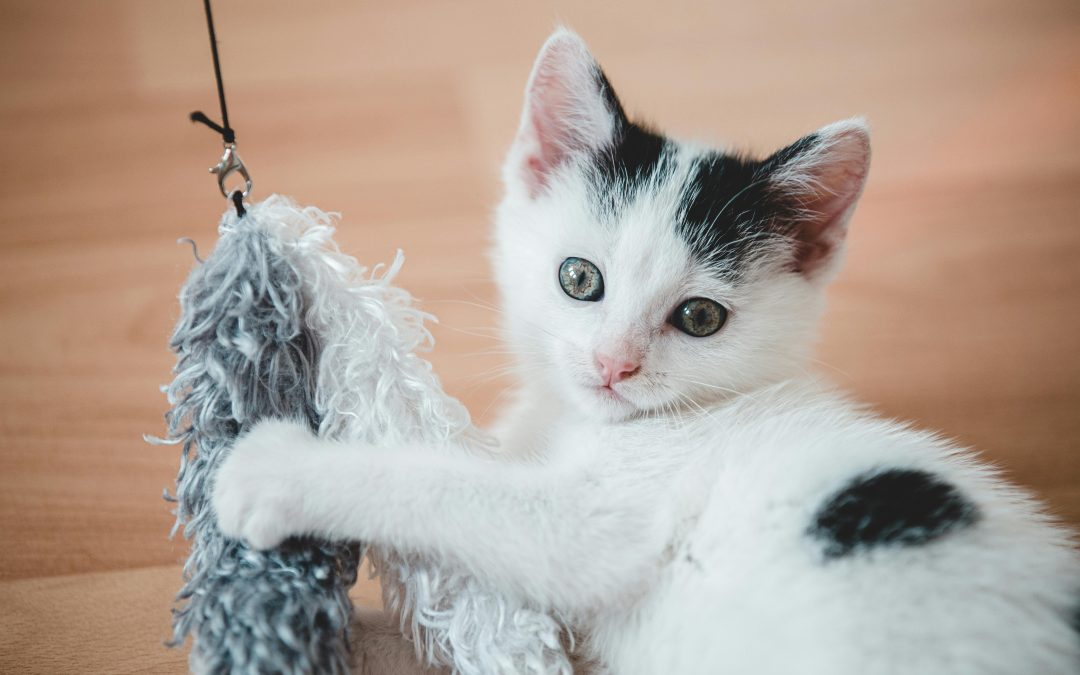
Our feline friends love toys and some toys are better than others. (6) Chase and pounce toys are great as they reproduce your cat’s natural interest in hunting. (1) Play with your cat using toys with dangling things, like ropes or like feathers at the end of a rod. (7) But best to remove these toys after play. Offer play mice and ping pong balls for play by themselves.
Tip: Cats get bored of their toys so rotating toys is best. Try a box containing several different toy options and see which one your sweet friend picks! (7)
A Note on Laser Pointers: Be sure to offer an actual object for pouncing when using a laser point with your kitty, Without this, a laser pointer can frustrate your best friend. (6)
Scents
Try offering your kitty a cloth or towel with catnip or catnip scent on it. Many cats really like catnip and will be very interested! If your cat isn’t into catnip, no big deal. Try a FELIWAY ®, a synthetic pheromone. (6)
Interesting: A cat’s response to catnip is inherited and typically lasts about 15 minutes!
Remember:
Every cat is an individual! Try some of these suggestions and see what your kitty likes.
The importance of providing the perfect litter boxes cannot be overstated! (1, 17) Check out indoorpet.osu.edu for all the info.
Body language speaks volumes when it comes to your special friend. (6) Check out alleycat.org to interpret your cat’s clues.
For many cats, nothing beats quality time with you! (14)
References:
- Herron ME, Buffington CA. Environmental enrichment for indoor cats. Compend Contin Educ Vet. 2010 Dec;32(12):E4. PMID: 21882164; PMCID: PMC3922041.
- Kogan L, Kolus C, Schoenfeld-Tacher R. Assessment of Clicker Training for Shelter Cats. Animals (Basel). 2017 Sep 22;7(10):73. doi: 10.3390/ani7100073. PMID: 28937608; PMCID: PMC5664032.
- Buffington CA. External and internal influences on disease risk in cats. J Am Vet Med Assoc. 2002 Apr 1;220(7):994-1002. doi: 10.2460/javma.2002.220.994. PMID: 12420776.
- Overall KL, Rodan I, Beaver BV, Carney H, Crowell-Davis S, Hird N, Kudrak S, Wexler-Mitchel E; Panel on Feline Behavior Guidelines; American Association of Feline Practitioners. Feline behavior guidelines from the American Association of Feline Practitioners. J Am Vet Med Assoc. 2005 Jul 1;227(1):70-84. doi: 10.2460/javma.2005.227.70. PMID: 16013540.
- Crouse SJ, Atwill ER, Lagana M, Houpt KA. Soft surfaces: a factor in feline psychological well-being. Contemp Top Lab Anim Sci. 1995 Nov;34(6):94-7. PMID: 16457540.
- Ellis SL. Environmental enrichment: practical strategies for improving feline welfare. J Feline Med Surg. 2009 Nov;11(11):901-12. doi: 10.1016/j.jfms.2009.09.011. PMID: 19857853; PMCID: PMC11383019.
- Overall KL, Dyer D. Enrichment strategies for laboratory animals from the viewpoint of clinical veterinary behavioral medicine: emphasis on cats on dogs. ILAR J. 2005;46(2):202-15. doi: 10.1093/ilar.46.2.202. PMID: 15775029.
- Jansson, H., et al. (2014). “Environmental enrichment for pet cats.” Journal of Applied Animal Welfare Science, 17(2): 142-150.
- Cafazzo, S., et al. (2018). “The effect of environmental enrichment on stress and welfare in cats.” Journal of Veterinary Behavior, 26: 12-18.
- Heidenberger, E. (1997). “The influence of environmental enrichment on the behavior of domestic cats.” Applied Animal Behaviour Science, 53(3): 147-156.
- Overall, K. L. (2013). Manual of Clinical Behavioral Medicine for Dogs and Cats. Elsevier Health Sciences.
- Dantas LM, Delgado MM, Johnson I, Buffington CT. Food puzzles for cats: Feeding for physical and emotional wellbeing. J Feline Med Surg. 2016 Sep;18(9):723-32. doi: 10.1177/1098612X16643753. Epub 2016 Apr 21. PMID: 27102691; PMCID: PMC11148901.
- Kennedy CJ, Thomson AE, Griffith EH, Fogle J, Lascelles BDX, Meeker RB, Sherman BL, Gruen ME. Enrichment Preferences of FIV-Infected and Uninfected Laboratory-Housed Cats. Viruses. 2018 Jul 3;10(7):353. doi: 10.3390/v10070353. PMID: 29970792; PMCID: PMC6071041.
- Vitale Shreve KR, Mehrkam LR, Udell MAR. Social interaction, food, scent or toys? A formal assessment of domestic pet and shelter cat (Felis silvestris catus) preferences. Behav Processes. 2017 Aug;141(Pt 3):322-328. doi: 10.1016/j.beproc.2017.03.016. Epub 2017 Mar 24. PMID: 28343989.
- Grant, R.A.; Warrior, J.R. Clicker Training Increases Exploratory Behaviour and Time Spent at the Front of the Enclosure in Shelter Cats; Implications for Welfare and Adoption Rates. Appl. Anim. Behav. Sci. 2019, 211, 77–83.
- Rossi AP, Dos Santos CRC, Maia CM, Terzian CCB, Predebon DF, de Queiroz JSC, Pereira LPM, Bastos MZN, Choinski M, Tsapatsis PE, de Assis SRM, Corrêa TM. Rescued Cats Prefer to Scratch Fabrics Commonly Used to Cover Upholstered Furniture. J Appl Anim Welf Sci. 2023 Jul-Sep;26(3):313-324. doi: 10.1080/10888705.2021.1949595. Epub 2021 Jul 19. PMID: 34279154.
- Neilson J. Thinking outside the box: feline elimination. J Feline Med Surg. 2004 Feb;6(1):5-11. doi: 10.1016/j.jfms.2003.09.008. PMID: 15123161; PMCID: PMC10822439.